
DENTAL TECHNICIAN > CONICO AND PRAMA
The Conico system allows an implant supported fixed prosthetic to be obtained without using cement or fixing screws between the abutment and the prosthesis, which is, at the same time easily removable by the clinician. Like screw-retained and cemented solutions, this is considered to be a fixed prosthesis whilst having the advantages of both. It can be revised yet it has no cement like aesthetic screw-retained prosthetics, and it has no holes in the occlusal area like cemented prostheses. Moreover, the ease of removal allows the health of the peri-implant tissues to be maintained properly, with considerable savings of time and costs for both the patient and the technician.
Rehabilitating Prama with a conometric prosthetic allows full use of these benefits together with the possibility of platform management far from bone and soft tissues.
I have used Prama implants, or rather, we have been fabricating prostheses on these platforms for several years now. Results have been very good both for the restoration of single missing teeth for predominantly aesthetic purposes and in areas where several teeth are missing. This has been especially true in many totally edentulous areas, which we have often managed with immediate loading. I mainly use screw-retained prosthetic solutions where, thanks to the rotating components, I can place the load directly on the implant head. I prefer the luting technique for temporaries whilst cad-cam solutions, where there is the possibility of inserting inclined screws, as required, to bring the hole inside the prosthetic body, are my choice for definitive restorations.
Aside from my initial scepticism, dictated by my preconceptions about this implant neck’s shape and diameter, which I believed were difficult to manage, I must admit that from the beginning I felt I had something available that would allow me, on the one hand, to bypass the use of abutments and to place the load directly on the implant head. On the other hand, I have found that I was able to manage “ideal” anatomical and emergency profiles whilst still keeping a certain amount of tissue around the implant. This is thanks to how versatile the positioning of this implant is, especially in an apico-coronal placement.

A solution that has been giving us a lot of satisfaction lately is the Conico conometric prosthesis on Prama implants. We increasingly prefer this technique for the advantages it offers under the right conditions such as no cement or no through holes for access to screws, which we know to be the Toronto’s weak point and especially for how easily the prosthesis can be removed by the dentist.
The Conico conometric system on Prama implants provides for dedicated straight and angled prosthetic components that can correct disparallelism between the implants in a simplified manner by creating a unique insertion axis for the prosthesis. These components have a positioning index (hexagonal/non-rotational) that makes our choice easier since we can perform this operation on the model instead of directly in the mouth. On these posts we use a specific secondary cap, which will be incorporated into the prosthetic with a luting system. Unavoidably, this operation has to be done in the mouth, ensuring however greater prosthetic precision and passivation.
It is always advisable to consider the footprint of the post and cap both as concerns the lingual vestibule and gingival occlusion. Therefore, the position of the implant in relation to the prosthetic should be carefully evaluated. I therefore believe that it is important to associate the use of the system with guided surgery.
In conclusion, I would like to take this opportunity to reiterate two fundamental things. First, whether or not Prama is used, we must first learn how to use these products based on their characteristics. Then, especially when working with implant prosthetics, proper planning and case design, where surgeons, prosthetics specialists and dental technicians are as involved as possible, cannot be ignored.
DT Massimo Soattin, Laboratorio Lab4M
ADVANTAGES OF CONOMETRIC REHABILITATION
-
Excellent retention: the connection between the conical cap incorporated in the over-structure and the post offers absolute and assured mechanical stability.
-
Ease of removal: the clinician can remove the prosthetic through the application of minimal force at any time for a check-up and/or for oral hygiene.
-
Easy to use: the upper portion of the posts is standard, so both straight and angled posts use the same conical cap..
-
Comfort for the patient who will enjoy the stability of a fixed prosthetic with the advantage of its easy removal at the dentist’s office during a professional oral hygiene visit.
-
Several rehabilitation options: the conometric technique allows rehabilitation from single elements to an entire arch with either immediate or deferred loading and with guided surgery.
-
Natural passivation of the posts guarantees a perfect fit between the prosthetic and the abutment.
CAPS FOR SPECIAL NEEDS
The Conico system includes a series of caps allowing the use of the conometric technique for both immediate or deferred loading even in combination with intraoral welding techniques.

The Conico system includes a series of caps allowing the use of the conometric technique for both immediate or deferred loading even in combination with intraoral welding techniques.
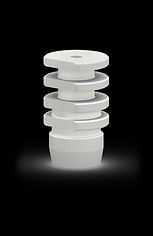
Cap for taking impressions:
when using PEEK, this cap allows the advantages of the One Abutment-One Time technique to be exploited by taking the impressions directly on the posts.

Conometric cap for partial or full-arch fixed prosthetics:
made of titanium, once incorporated into the prosthesis, the cap connects to the posts using the conometric concept, with no need for screws or cement.

Anti-rotational conometric cap for a single element: designed for single restorations, this cap has a flat face on the inner and outer surface, which aids in finding the correct positioning.

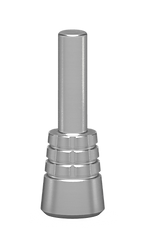
CAP2-TS-PIN cap for intraoral welding:
in immediate loading procedures the pin allows to splint the caps with the intraoral welding avoiding the risk of fusion between the cap and the post.
CAPS FOR SPECIAL NEEDS
CAP2-TS-REM cap for the removal: to be used exclusively in particular conditions of multiple rehabilitations or full-arch structures, in the case of patients with parafunctions.
The presence of an internal thread allows to engage a screw with M2 thread (e.g. screw code VM2-200) in order to deactivate the conometry and consequently remove the prosthesis.
PARALLELOMETER
The Parallelometer is a device for choosing the Conico post with the right angle and with the correct transgingival height. It is able to rotate on its own axis at 360 ° and the upper part of the instrument allows you to find the right parallelism, thus defining the angle that the post itself must have, thanks to the directional rod. The length of the transmucosal path is calibrated using the laser notch located in the lower part of the insert.